


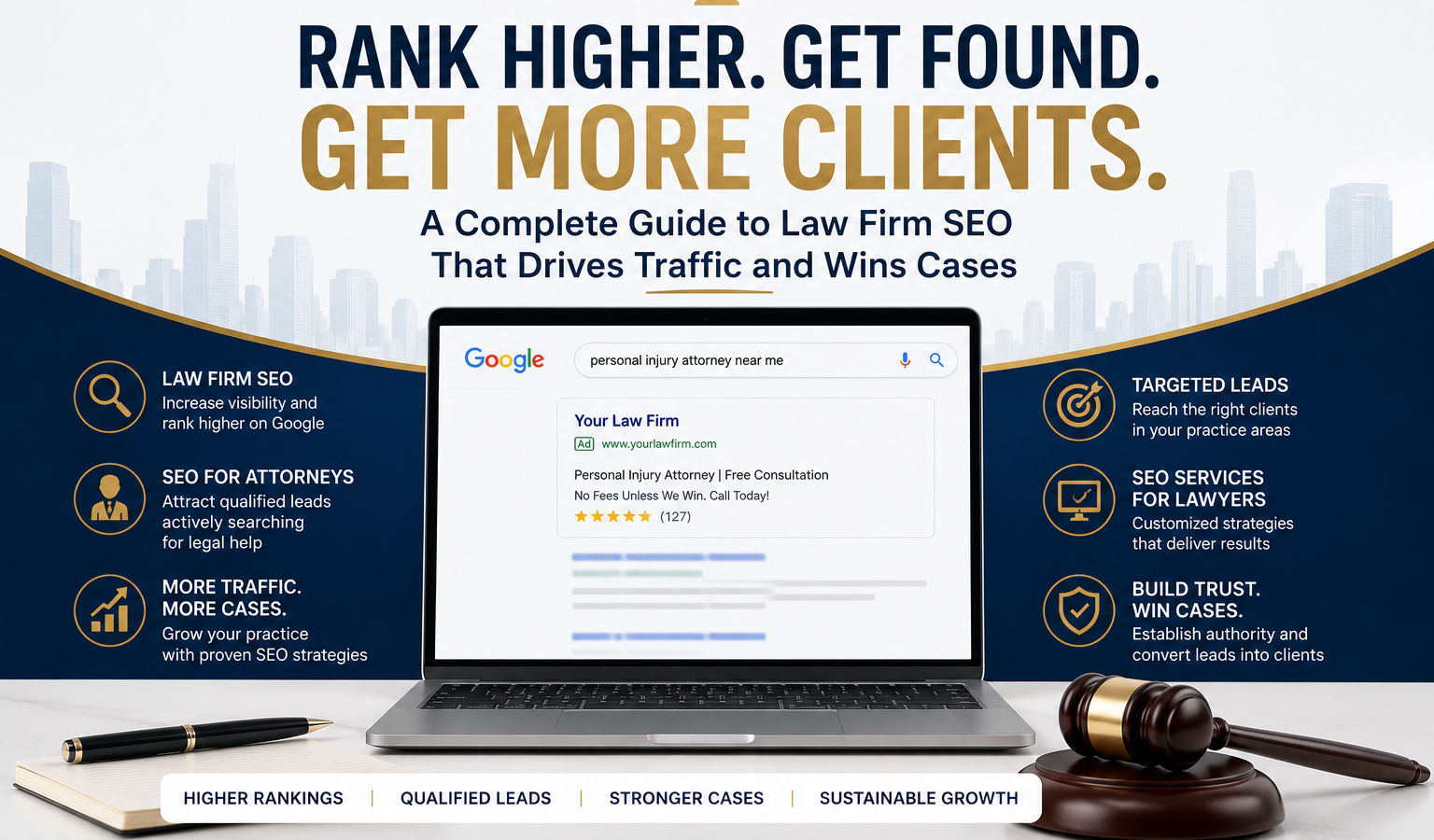
United Web World Guide to Law Firm SEO: How Attorneys Turn Search Visibility into Consultations
People rarely search for a lawyer casually. They search when the problem feels urgent, expensive, stressful, or time-sensitive. That is why the firms winning organic traffic are not just publishing more pages. They are building pages that answer the right questions at the right moment and make the next step easy.

Why law firm SEO matters now
Legal marketing has changed from “be visible somewhere online” to “be the clearest, most trustworthy answer for a specific legal need.” Prospects compare firms faster than ever. They bounce between Google, map results, law firm websites, online reviews, and even AI-generated summaries before deciding who deserves a call.
97%
of consumers read reviews for local businesses, which makes review visibility a legal marketing issue, not just a reputation issue.
71%
of consumers use Google to read local business reviews, reinforcing how closely local SEO and credibility are connected.
2.7x
more likely consumers are to view a business as reputable when its Business Profile is complete.
50%+
of consumers say they have used or would consider using AI for legal questions before speaking with a lawyer.
For law firms, those numbers translate into one thing: visibility without trust is weak, and trust without visibility is invisible. Consumers increasingly rely on reviews, complete local listings, and clear website information when deciding which professional service business deserves attention. A complete Business Profile also significantly improves perceived credibility and visit likelihood, which is a major advantage for legal practices competing locally. [BrightLocal](https://www.brightlocal.com/resources/local-seo-statistics/)
The legal side of consumer behavior is shifting too. More people say they would look online for their next lawyer, and firm websites plus reviews play a major role in that process. At the same time, more than half of consumers have used or would consider using AI to answer legal questions, which means law firm websites now need to perform well both for human readers and AI-assisted discovery paths. [Clio](https://www.clio.com/resources/legal-trends/read-online/)
This is why search engine optimization for law firms is no longer just a growth tactic. It is part of client acquisition, brand trust, and intake efficiency.
What United Web World provides
At United Web World, we provide law firm SEO, SEO for attorneys, SEO attorney strategy, lawyers SEO, attorney SEO marketing, SEO services for lawyers, attorney SEO services, personal injury attorney SEO, search engine optimization for law firms, and search engine optimization for lawyers.
That service mix is designed around how legal decisions really happen. A prospect may begin with a broad query, narrow down to a city or case type, compare multiple firms, scan reviews, and only then decide whether to call. Strong SEO supports every one of those micro-decisions. That means technical performance, service-page architecture, local optimization, internal links, schema, FAQs, and consultation design all matter together.
We also support legal growth with related services including a full SEO audit, advanced AI SEO, conversion-driven local SEO, guidance from an AI SEO agency, scalable white label SEO services, and a dedicated legal growth page for law firm SEO services.
How the legal buying journey really works
Step one: the prospect searches under pressure
Someone dealing with an injury, dispute, arrest, custody issue, immigration concern, or business conflict is usually not searching in a relaxed frame of mind. They want speed, clarity, and evidence of competence. The law firm that explains the issue cleanly often earns more trust than the firm that simply sounds more impressive.
Step two: they compare before they contact
Even if a referral exists, the referral is often validated online. People still want to see the firm’s website, attorney profiles, reviews, practice focus, and signs of legitimacy. That is why attorney SEO marketing is not separate from brand strategy. It is the mechanism that shapes first impression.
Step three: the website must reduce uncertainty
A good legal page should answer what the firm handles, who it is for, what the process looks like, and how the visitor can take the next step. That is especially true for SEO for attorneys in competitive categories, where tiny trust signals often determine who gets the first call.
Step four: AI search changes the way content is surfaced
Google’s current guidance emphasizes unique, helpful content, strong page experience, crawlability, and structured data that matches visible content. For lawyers, this means generic pages built from recycled legal definitions are becoming less useful, while clearer, more original, problem-solving content becomes easier to surface in both standard and AI-assisted search experiences. [Google Search Central](https://developers.google.com/search/blog/2025/05/succeeding-in-ai-search)

The five pillars of search engine optimization for lawyers
1. Practice-area clarity
Strong lawyers SEO starts with page specificity. One homepage should not be expected to rank for criminal defense, family law, personal injury, immigration, and estate planning all at once. Each core service deserves its own focused page with its own supporting intent.
2. Local trust architecture
People hire lawyers near them or within a relevant jurisdiction. That makes office details, service areas, review consistency, attorney bios, and map visibility central to performance. Local trust is often the first conversion layer, especially for mobile users.
3. Technical strength
Search engines need to crawl, interpret, and index your pages correctly. That means clean internal linking, mobile usability, fast load speed, descriptive titles, schema support, and avoiding duplicate or thin content. Technical SEO does not win cases by itself, but weak technical SEO can absolutely suppress growth.
4. Authority-driven content
The best legal content is not just long. It is useful. It addresses client concerns, explains next steps, and clarifies what the firm actually does. This is particularly important for personal injury attorney SEO, where prospects want fast answers about liability, medical treatment, insurance pressure, and compensation questions.
5. Consultation-first conversion design
Great rankings should lead to clearer intake. Every high-value page should make the next action obvious with visible phone numbers, concise contact forms, consultation prompts, and reassurance about what happens after contact. Search performance improves when the page also improves user confidence.
| Pillar | Main Goal | What It Looks Like | Primary KPI |
|---|---|---|---|
| Practice-area clarity | Intent match | One focused page per service or legal issue | Rankings by page |
| Local trust | Credibility | Reviews, GBP quality, local proof points, attorney bios | Calls and map actions |
| Technical strength | Indexation and performance | Fast pages, clean structure, schema, mobile UX | Indexed URLs and Core Web Vitals |
| Authority content | Relevance and trust | Helpful legal pages, FAQs, supporting articles | Organic entrances and engagement |
| Conversion design | Lead capture | Simple forms, strong CTAs, intake guidance | Consultations and form fills |
A practical SEO roadmap for attorneys
-
Audit the firm’s search footprint.
Review what ranks now, what practice areas are underrepresented, where local signals are weak, and which pages attract traffic without producing inquiries. -
Rebuild service-page intent.
Each core legal service should have a dedicated page with clear subtopics, FAQs, trust cues, and action-oriented copy. -
Strengthen the attorney layer.
Attorney bios, bar admissions, case focus, experience, and recognitions can support trust and improve on-page depth when used naturally. -
Create a content bridge between questions and services.
Educational pages should feed into service pages rather than exist as isolated traffic posts. This is where smart SEO services for lawyers outperform content-for-content’s-sake publishing. -
Improve consultation pathways.
Make the first step obvious. Clarify whether the consultation is free, what documents may be helpful, and how soon someone can expect a reply. -
Support discovery beyond blue links.
Add images, well-structured headings, FAQ-ready copy, and strong internal linking so content performs better in modern search experiences. -
Track business outcomes, not vanity rankings.
If a page ranks but never produces calls, the issue may be trust, relevance, or intake design rather than visibility alone.
Practical takeaway: Search engine optimization for law firms works best when each page has one clear job, one clear audience, and one clear next step.
Examples and mini case study
Three page types that often outperform generic legal pages
- Core service page: A page focused entirely on a practice area, such as truck accidents, divorce litigation, or business disputes.
- Decision-support page: A page answering a high-friction question like “Do I need a lawyer after a rear-end collision?”
- Expectation page: A page explaining what happens after a consultation request, which reduces anxiety and improves conversion.
Mini case study: illustrative scenario
A multi-service law firm had strong brand recognition but inconsistent organic performance. Its homepage ranked for branded terms, yet non-branded legal searches often led to weaker competitors. The issue was not a lack of content volume. It was poor search architecture. Practice-area pages were thin, attorney bios were underdeveloped, and blog posts were not linked strategically to revenue-driving pages.
After restructuring the site around service clusters, strengthening local trust elements, and improving consultation-focused calls to action, the site became easier for both prospects and search engines to understand. That is the key difference between random content production and structured attorney SEO services. Good SEO does not just create more pages. It creates a clearer route from search to contact.
Why personal injury attorney SEO deserves its own strategy
Personal injury attorney SEO is often more competitive than general legal SEO because the stakes are high and the search intent is commercial. Prospects are comparing urgency, credibility, results, availability, and locality. That means pages for car accidents, truck accidents, wrongful death, slip-and-fall cases, and insurance disputes should not be buried under a generic injury overview. They need their own targeted relevance and conversion flow.
Common attorney SEO mistakes
The first mistake is treating all legal services as one topic. Search engines and users both prefer specificity, especially when the legal issue is complex.
The second mistake is publishing long but interchangeable content. Word count alone is not a strategy. Useful structure, intent match, and readability matter more.
The third mistake is hiding the attorneys behind brand-only messaging. People still hire people. A firm site should make the legal team visible, credible, and easy to evaluate.
The fourth mistake is ignoring local and review signals. Even exceptional content can underperform if the surrounding trust ecosystem looks weak.
The fifth mistake is measuring SEO by traffic only. Good search engine optimization for lawyers should be evaluated by qualified consultations, intake quality, and signed matters, not just chart growth.
FAQs
What is law firm SEO?
Law firm SEO is the process of improving a legal website’s visibility in search engines so prospective clients can find the firm when they need legal help and convert into consultations.
Why is SEO for attorneys different from general business SEO?
SEO for attorneys is more trust-sensitive and more intent-driven. Prospects often search during stressful situations, compare multiple firms quickly, and need a higher level of reassurance before contacting anyone.
What do attorney SEO services usually include?
Attorney SEO services usually include technical audits, practice-area optimization, local SEO, content strategy, internal linking, review support, schema implementation, and conversion analysis.
How long does lawyer SEO take to show results?
Most firms see early SEO improvement within 3 to 4 months, while stronger gains in non-branded traffic, local visibility, and lead quality usually build over 6 to 9 months.
Is personal injury attorney SEO worth doing separately?
Yes. Personal injury searches are highly competitive and high intent. Separate strategy, page structure, and conversion design often produce better results than treating injury law as one broad category.
Want a stronger legal search strategy?
If your firm needs better rankings, stronger trust signals, and more qualified consultations, United Web World can help you build a legal SEO system that connects visibility, authority, and conversion.
Author bio

United Web World Editorial Team
The United Web World Editorial Team specializes in SEO strategy, local search growth, AI-ready content systems, and conversion-focused website optimization. Our editorial approach combines practical ranking knowledge, current search behavior insights, and real-world growth strategy for professional service firms that need more than surface-level traffic.