


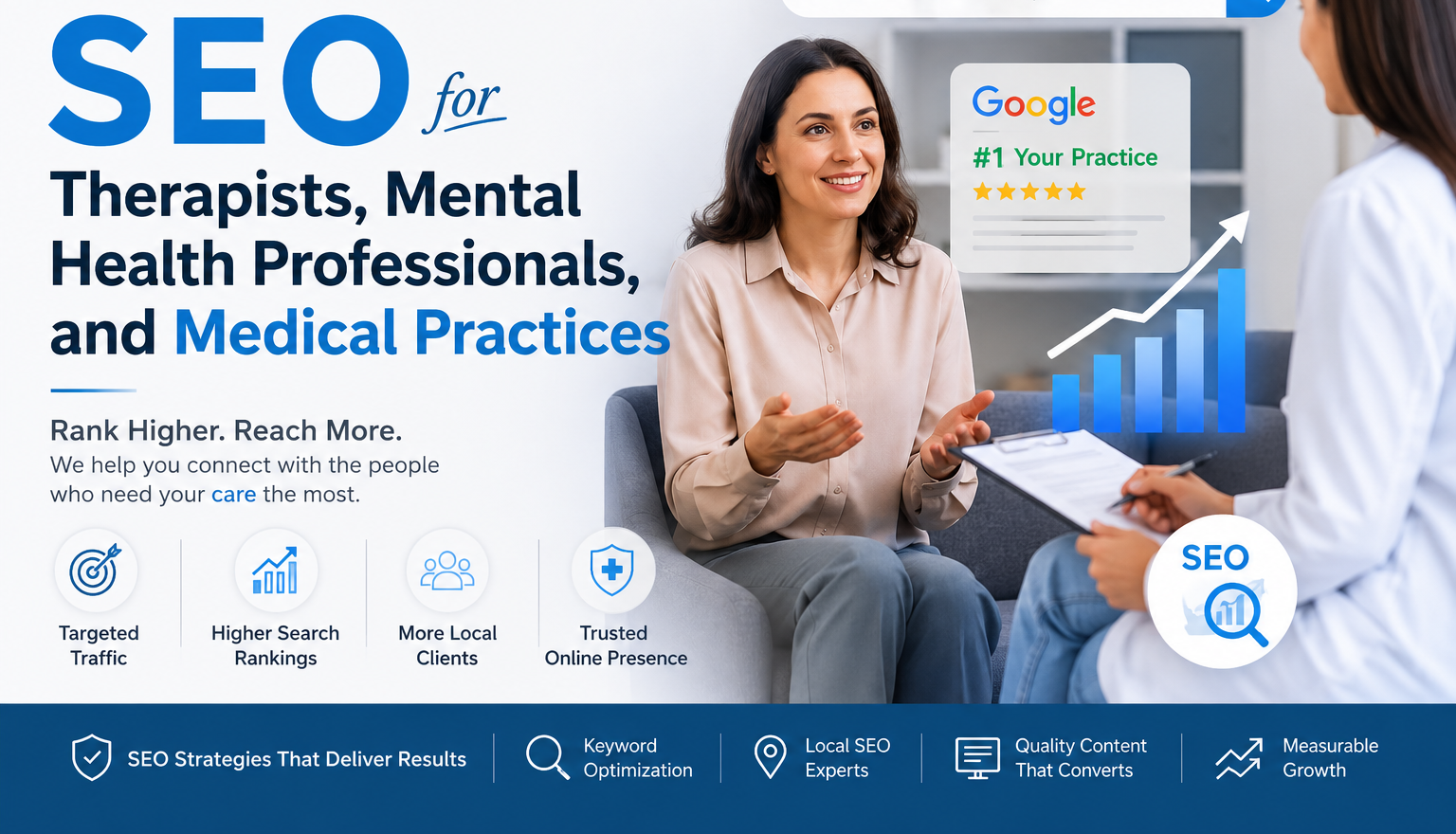
SEO for Therapists, Mental Health Professionals, and Medical Practices: A 2026 Growth Guide by United Web World
When someone searches for a therapist, counselor, or medical clinic, they rarely browse for long. They choose the result that feels relevant, trustworthy, and easy to contact. That is why modern SEO is not just about rankings. It is about showing up at the right moment with the right message and turning that visit into a booked consultation.

Why this matters now
Search behavior for healthcare and counseling has changed fast. People no longer search only once, click one page, and convert. They compare profiles, skim reviews, ask follow-up questions in AI search experiences, and expect websites to answer practical concerns immediately. That means a therapist website or clinic website must be discoverable, trustworthy, fast, and genuinely helpful.
97%
of consumers read reviews for local businesses.
80%
of U.S. consumers search online for local businesses weekly.
45%
use generative AI tools for local business recommendations.
38.8%
of psychiatric patients in one study searched online for mental health services.
Those numbers are especially important for service-based healthcare brands. BrightLocal reports that 97% of consumers read reviews for local businesses, 80% search online for local businesses every week, and 45% already use generative AI tools for local recommendations. In other words, the path to discovery now includes both traditional local search and AI-assisted decision-making [BrightLocal].
For mental health providers, digital discovery is not theoretical. A study indexed by the National Center for Biotechnology Information found that 70.9% of internet-using psychiatric patients went online for mental-health-related reasons, while 57.8% searched for information on mental disorders and 38.8% searched for mental health services and professionals. If your website does not show up clearly and credibly, another practice will capture that demand [NCBI].
That is why SEO for therapists, mental health clinics, and medical practices now sits at the intersection of visibility, reputation, content quality, and conversion strategy. The winning websites are not simply “optimized.” They are built to help people take the next step with confidence.
What United Web World provides
At United Web World, we provide seo for therapists, therapist seo, seo for medical websites, therapy seo, seo for mental health professionals, seo for mental health, seo for medical clinics, mental health seo, medical local seo, local seo for medical practices, seo marketing for therapists, seo for therapist website design support, seo for therapist website content optimization, seo for therapist growth campaigns, local seo for medical marketing, seo for mental health counselors, private practice seo, and google seo for therapists.
That service mix is not just about rankings. It is about building the digital journey from search to scheduled consultation. Some practices need a technical cleanup and a stronger site structure. Others need location pages, specialty pages, FAQs, review generation systems, or an AI-search-ready content plan. Many need all of it working together.
We also support related growth services such as a full SEO audit, advanced AI SEO, performance-led medical local SEO, strategy from an AI SEO agency, and scalable white label SEO services for partners who serve healthcare and wellness clients.
The result is a more complete growth engine: stronger rankings, clearer service positioning, better local trust, and more qualified inquiries from people who are already searching for help.
How modern SEO works for therapy and medical brands
Start with search intent, not just keywords
The best therapist and medical websites no longer build one generic service page and hope it ranks for everything. Search intent is more nuanced now. Someone searching “anxiety therapist near me” needs local trust and ease of booking. Someone searching “EMDR therapy for trauma” needs a page that explains the approach clearly. Someone searching “child counselor accepting new patients” needs a page that addresses fit, process, and availability. Real SEO performance comes from matching each query with the exact page type that satisfies it.
Build trust signals into every high-intent page
Healthcare and counseling decisions are trust-heavy. Your pages should include practitioner credentials, conditions treated, therapy modalities, service areas, accepted insurance if applicable, clear CTAs, and honest expectations. Reviews and profile completeness also matter. BrightLocal highlights that customers are 2.7 times more likely to consider a business reputable if it has a complete profile, and businesses with complete profiles are more likely to receive visits and purchase consideration [BrightLocal].
Prepare for AI search and richer results
Google’s 2025 guidance for AI search experiences is clear: create unique, helpful content for people, ensure a strong page experience, keep your content crawlable, and make sure structured data matches what users can actually see on the page. In practice, that means shallow pages will lose ground while expert, specific, clearly structured pages become more valuable [Google Search Central].
For therapy SEO and SEO for medical websites, this is a major opportunity. Practices that publish specialized, localized, well-structured content can become the source that search engines and AI systems prefer to reference. That is why content depth, FAQ markup, service clarity, image optimization, and strong internal linking matter more than ever.

Use topic clusters, not isolated blog posts
A single blog post will not carry your whole strategy. Instead, your website should work like a topical ecosystem. A core service page might target couples counseling in a city. Supporting pages can answer related questions about costs, first-session expectations, online therapy, insurance, trauma-informed care, or specific treatment methods. This improves semantic relevance, internal linking, featured snippet opportunities, and user trust at the same time.
What moves rankings and inquiries
Below is a practical view of the elements that most often make the difference for therapists, counselors, and clinics trying to grow through organic search.
| Ranking / Conversion Element | Why It Matters | What to Do | KPI to Watch |
|---|---|---|---|
| Service page depth | Helps Google understand topic relevance and helps users self-qualify. | Create dedicated pages for specialties, audiences, and treatment types. | Organic leads per page |
| Local relevance | Critical for “near me,” city, and map-pack searches. | Optimize service areas, local copy, GBP, and NAP consistency. | Calls, directions, local rankings |
| Reviews and reputation | Influences trust, click-through rate, and conversions. | Request reviews consistently and respond professionally. | Review volume and rating trend |
| Technical SEO | Ensures pages are crawlable, fast, mobile-friendly, and indexable. | Fix speed, indexing, schema, broken links, and duplicate content. | Core Web Vitals, indexed pages |
| Conversion UX | Traffic means little if users do not contact you. | Improve CTAs, forms, trust elements, and contact pathways. | Form fills, calls, consultation requests |
Featured snippet takeaway: The fastest wins usually come from improving page specificity, local trust signals, Google Business Profile quality, and conversion UX before publishing large amounts of new content.
A practical step-by-step plan
-
Audit the site from a patient-first perspective.
Review your website as if you were a first-time visitor in distress or in a hurry. Can someone instantly tell who you help, where you are, what services you offer, and how to contact you? This is where many therapist SEO campaigns fail before technical work even begins. -
Map one keyword theme to one high-intent page.
Avoid forcing ten search intents into one page. Build separate pages for core services such as anxiety therapy, trauma therapy, couples counseling, psychiatric evaluations, telehealth, or location-specific care. That is how SEO for therapist website growth becomes measurable rather than vague. -
Strengthen local foundations.
Medical local SEO and local SEO for medical practices depend on clear business details, accurate categories, strong local landing pages, service area cues, and ongoing review acquisition. If your local signals are weak, your national content will not save local lead generation. -
Create content that answers real pre-booking questions.
The strongest therapy SEO content does not chase traffic for vanity keywords. It answers the questions people ask before they commit: How do I know if this therapy is right for me? What happens in the first session? Do you offer online appointments? Do you work with teens, couples, or trauma survivors? -
Optimize for AI search visibility.
Use concise definitions, scannable subheadings, original insights, schema markup, and clearly labeled FAQs. According to Google’s guidance, pages that are unique, accessible, and visibly aligned with their structured data are better positioned for modern search experiences [Google Search Central]. -
Improve conversion paths.
Every important page should make the next step obvious. Add a short intake CTA, phone tap links on mobile, a brief “what to expect” section, and trust-building proof points. SEO marketing for therapists is incomplete if the site attracts traffic but creates hesitation at the decision point. -
Measure leads, not just rankings.
Rankings are useful, but booked calls, consultation forms, direction requests, and high-quality inquiries are the true scoreboard. Private practice SEO works best when content, local SEO, and CRO are tracked together.
Examples and mini case study
Below is a simple example of how a therapist or clinic website can turn broad traffic into more qualified leads without publishing low-value content at scale.
Mini case study: illustrative example
A private counseling practice had one generic “Services” page trying to rank for anxiety, trauma, couples therapy, teen counseling, and online therapy. The site also had weak local signals and almost no internal linking. Instead of publishing 50 random blog posts, the strategy focused on five improvements: separate service pages, city-focused local optimization, better page titles and meta descriptions, FAQs on each service page, and stronger calls to action.
Within the next phase of optimization, the site became easier to understand for both users and search engines. More importantly, inquiries improved in quality because visitors reached pages tailored to their actual needs. This is a common pattern in seo for mental health professionals and seo for medical clinics: relevance beats volume when the service is personal and high trust.
Three page examples that work well
- Service page: “EMDR Therapy for Trauma in [City]” with symptoms, treatment approach, ideal fit, FAQs, and booking CTA.
- Audience page: “Counseling for Teens and Parents” with trust-building explanations and intake expectations.
- Local page: “Anxiety Therapist Near [Neighborhood or City]” with location relevance, testimonials, map cues, and contact info.
That is the difference between generic content and strategic content architecture. Strong mental health SEO meets the reader at the exact stage of awareness they are in, then reduces uncertainty enough for them to take action.
Common mistakes to avoid
The first mistake is building a website around the business owner’s language rather than the patient’s search language. A page that says “holistic integrative emotional support framework” may sound sophisticated, but it may not rank or convert as well as a page that clearly addresses anxiety therapy, burnout counseling, or trauma recovery.
The second mistake is relying on one homepage to rank for everything. This weakens relevance and makes it difficult to win for competitive queries like seo for mental health counselors, seo for medical websites, or local seo for medical marketing-focused pages.
The third mistake is ignoring reputation and local signals. If your reviews are stale, your business details are inconsistent, or your profile looks incomplete, users may leave before they ever reach your website. BrightLocal’s local search data makes it clear that profile accuracy and review visibility strongly influence trust and action [BrightLocal].
The final mistake is producing AI-generated filler content with no expertise, no local angle, and no practical value. In 2026, that is not a shortcut. It is a liability.
FAQs
How long does SEO for therapists take to show results?
Most practices start seeing meaningful movement in 3 to 4 months, while stronger lead flow often takes 6 to 9 months. Timelines depend on competition, local market strength, website quality, review profile, and how aggressively the content and local strategy are executed.
What is the difference between therapist SEO and local SEO?
Therapist SEO is the broader system. It includes service pages, blog strategy, technical improvements, authority signals, and conversions. Local SEO is the location-focused layer inside that system, helping you show up for map results, city searches, and “near me” queries.
Why is Google SEO for therapists different from general SEO?
Because trust, sensitivity, and specialization matter more. People searching for therapy or medical care often need reassurance, clarity, and fast access to the right provider. Your content has to rank, but it also has to feel safe, specific, and professionally credible.
Can one website target both therapy SEO and medical local SEO?
Yes, if the site structure is clear. Each service category should have its own dedicated pages, internal links, and conversion paths. This avoids confusing users and helps search engines understand the distinct intent behind each topic cluster.
What should I do first if my rankings are flat?
Start with an audit. Usually the fastest wins come from fixing technical issues, improving page intent, strengthening local signals, and rewriting weak service pages. Publishing more blogs before that often adds noise rather than results.
Ready to grow with a smarter SEO strategy?
If you want a practical growth plan for seo for therapists, private practice seo, seo for mental health, or seo for medical clinics, United Web World can help you build a strategy that is local, AI-ready, and conversion-focused from day one.
Author bio

United Web World Editorial Team
The United Web World Editorial Team specializes in SEO strategy, local search growth, AI-search readiness, content architecture, and conversion-focused website optimization. Our work is shaped by real-world experience helping service businesses improve search visibility, strengthen trust signals, and turn organic traffic into qualified leads. We create content with an E-E-A-T mindset: practical experience, strategic insight, and clear guidance businesses can actually use.