


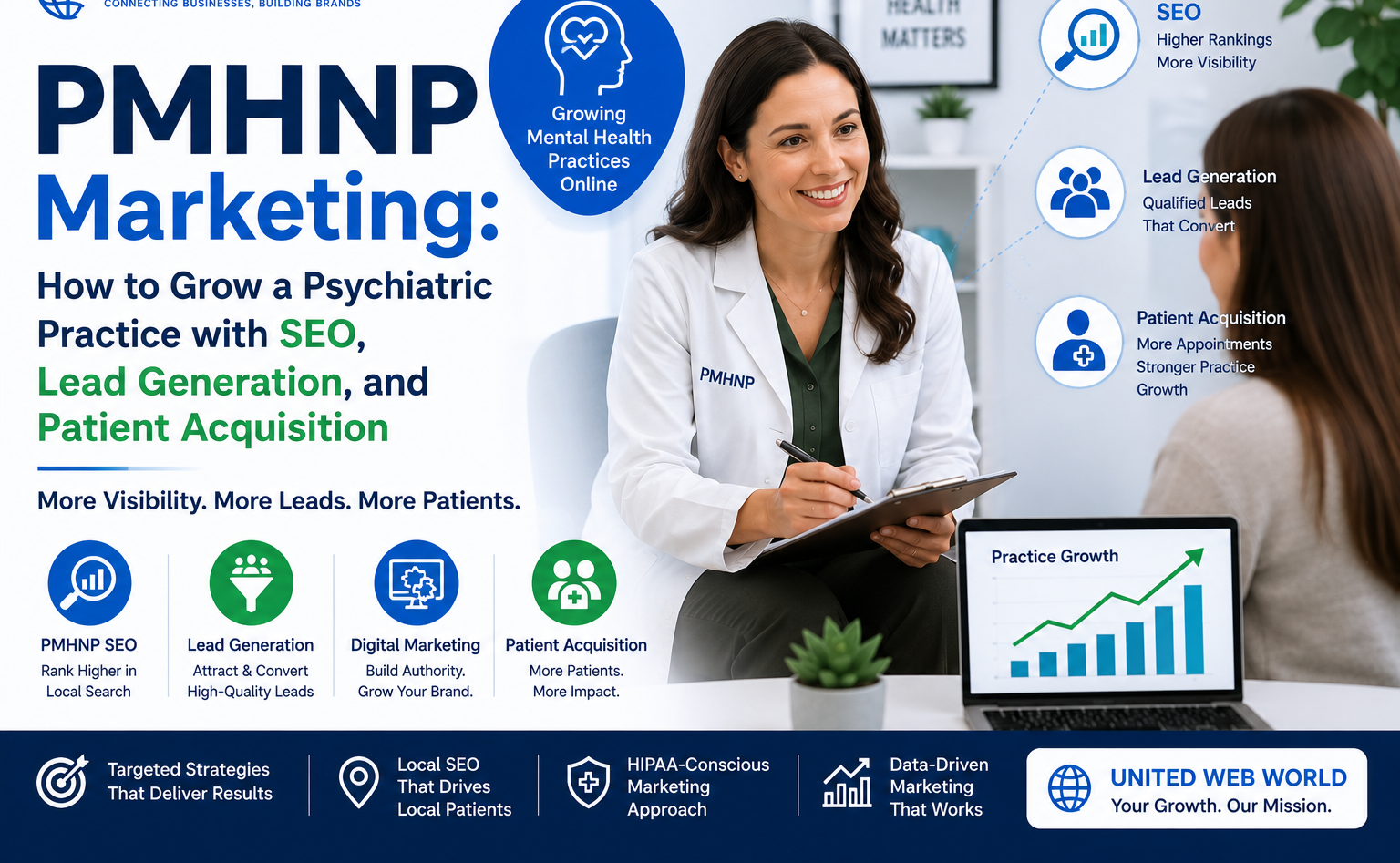
PMHNP Marketing: The Smartest Way to Grow Visibility, Leads, and Patient Acquisition in 2026
If you run a psychiatric practice, visibility alone is not enough. Prospective patients need to find you, trust you, and feel confident enough to book. That is what modern PMHNP marketing is really about: turning online attention into real appointments without sounding generic or salesy.
Updated for 2026 SEO, AI search, and local patient acquisition trends
Why PMHNP marketing matters now
Patients are not choosing providers the same way they did a few years ago. They search Google, compare websites, scan reviews, check availability, and often ask AI-powered tools follow-up questions before ever making contact. That means psychiatric nurse practitioner marketing is no longer just about having a website. It is about building a digital presence that answers intent, earns trust, and reduces friction.
97%
of consumers read reviews for local businesses.
62%
would avoid a business if they found incorrect information online.
45%
use generative AI tools for local business recommendations.
38.8%
of internet-using psychiatric patients searched online for mental health services.
For PMHNPs, those numbers matter. BrightLocal reports that 97% of consumers read reviews, 62% would avoid a business with incorrect online information, and 45% already use generative AI tools for local business recommendations. For a mental health practice, that means accuracy, reputation, and discoverability are all directly tied to growth.
On the patient side, the digital intent is also very real. A psychiatric patient study indexed in PubMed Central found that 57.8% of internet users searched online for information about mental disorders, while 38.8% searched for mental health services and professionals. That is a strong signal that mental health marketing should begin where patients already look: online.
This is why pmhnp marketing, pmhnp online marketing, and pmhnp digital marketing are no longer optional growth activities. They are part of how a modern practice becomes visible and credible in a crowded search environment.
What PMHNP marketing includes
A lot of practices think marketing starts and ends with social posts or a few ads. In reality, PMHNP marketing is a system. When it works well, every part reinforces the others. Your website improves trust. Your SEO increases qualified traffic. Your Google profile drives local visibility. Your reviews improve conversion. Your content answers real questions. Your forms and scheduling process turn interest into booked appointments.
Core areas of a strong PMHNP growth strategy
| Marketing Area | What It Does | Why It Matters for PMHNPs |
|---|---|---|
| PMHNP SEO | Improves rankings for relevant searches | Helps you appear for medication management, anxiety, depression, telepsychiatry, and local intent searches |
| Local optimization | Builds map visibility and location trust | Critical for nearby searches and reputation-driven clicks |
| Website UX | Turns visitors into inquiries | Mental health decisions depend on comfort, clarity, and trust |
| Content strategy | Answers patient questions before they call | Improves trust and long-tail visibility |
| Lead tracking | Measures where patients come from | Helps you improve PMHNP lead generation and PMHNP patient acquisition |
That is the difference between basic pmhnp internet marketing and strategic pmhnp practice marketing. One creates activity. The other creates measurable patient growth.
It also explains why some practices eventually look for a PMHNP marketing agency or specialized PMHNP marketing services. The right partner is not just running campaigns. They are aligning search visibility, patient psychology, and conversion performance into one system.
How SEO, local search, and AI search work together
PMHNP SEO is your long-term growth engine
PMHNP SEO is about showing up when someone searches for your services in a way that matches what they actually need. That includes service pages, local pages, FAQ sections, title tags, internal links, structured content, and strong technical foundations. If your practice offers medication management, ADHD support, anxiety treatment, depression care, or telepsychiatry, each of those services should be easy to find and easy to understand.
SEO for PMHNP is especially important because intent is often specific. Prospective patients are not always searching for “mental health provider.” They may search “psychiatric nurse practitioner near me,” “medication management online,” or “PMHNP for anxiety and depression.” The more clearly your site maps to those needs, the better your visibility and conversion potential.
Local trust is not optional in mental health marketing
Mental health marketing is deeply trust-driven. A strong Google Business Profile, accurate hours, consistent contact info, and authentic reviews all affect whether someone chooses to click. If your information is inconsistent, people often leave before reading a single paragraph of your site. That is why local credibility should be treated as part of psychiatric practice marketing, not as an afterthought.
AI search rewards specificity and usefulness
According to Google’s 2025 guidance, content performs better in AI search experiences when it is unique, useful, technically accessible, and clearly structured. Google also emphasizes good page experience, crawlability, and structured data that matches visible page content. In plain English, thin pages and vague copy are becoming easier to ignore.
For PMHNPs, this creates a real opportunity. If your site includes clear service pages, direct answers, helpful FAQs, practical explanations, and strong local context, you have a better chance of being surfaced in both classic search and AI-assisted discovery. This is where pmhnp seo services become more valuable than generic SEO packages. They need to fit how mental health patients actually search and decide.
The best marketing channels for PMHNP growth
1. Website and conversion copy
Your website is not a brochure. It is your primary conversion asset. It should quickly answer who you help, what conditions you treat, whether you offer medication management, whether telehealth is available, how to book, and what the first step looks like. A high-ranking page that feels cold or confusing will still lose the patient.
2. Content that answers pre-booking questions
Strong psychiatric nurse practitioner marketing often comes from answering the questions patients are already asking: Do I need medication management? What is the difference between a PMHNP and a psychiatrist? What happens at the first appointment? Can I combine therapy and medication support? These topics support both SEO and patient confidence.
3. Local SEO and review development
If your practice serves a region or city, local optimization should be one of the first priorities. Review signals, service-area copy, location pages, and complete business listings often generate faster wins than random blog publishing. This is a key pillar of pmhnp online marketing because it improves visibility where buying intent is strongest.
4. Paid search and retargeting
Paid campaigns can support faster lead flow, especially for newer practices. But they work best when the landing page and trust signals are already strong. Without that, ad spend can produce low-quality leads or expensive clicks that do not convert. PMHNP digital marketing should use paid channels as an amplifier, not a replacement for SEO and brand trust.
5. Online scheduling and friction reduction
Even small operational improvements can support patient growth. A recent healthcare scheduling study found that online-booked appointments had a lower no-show rate than offline-booked ones, and online scheduling reduced unused and never-booked appointments. That suggests smoother digital access can help support stronger patient acquisition outcomes.
How to improve PMHNP lead generation and patient acquisition
PMHNP lead generation is not just about getting more form fills. It is about attracting the right patients, making it easy for them to act, and tracking what actually results in booked appointments. PMHNP patient acquisition goes one step further by measuring the full path from visibility to inquiry to attendance.
-
Create one focused page for each major service.
Medication management, ADHD evaluations, anxiety treatment, depression support, telepsychiatry, and specialty populations should not be buried on one generic page. -
Use intent-based headings and FAQs.
This helps both search engines and anxious, time-sensitive visitors understand what you offer. -
Strengthen your Google Business Profile and reviews.
That improves local visibility, trust, and click-through rate. -
Make booking easy.
Simplify forms, add mobile-friendly calls to action, and clearly explain the next step. -
Track real outcomes.
Watch calls, consultation requests, online bookings, and show rates, not just traffic.
Simple truth: If your site gets traffic but not inquiries, the issue may not be visibility. It may be positioning, trust, or friction. That is why pmhnp practice marketing should always connect SEO with conversion strategy.
Mini case study and examples
Example scenario
A PMHNP practice had one homepage, one short services page, and inconsistent business information across the web. The site received some traffic, but inquiries were inconsistent and many visitors dropped off quickly. Instead of publishing generic posts every week, the practice focused on a clearer structure: dedicated service pages, stronger local signals, better FAQs, a more trust-focused homepage, and a simpler booking flow.
That approach typically improves performance because it aligns visibility with intent. When someone searching for medication management or telepsychiatry lands on a page built exactly for that need, conversions rise. This is the practical difference between broad mental health marketing and precise PMHNP marketing.
Three examples of high-value content
Example 1: “What does a PMHNP treat?” — useful for first-time visitors comparing provider types.
Example 2: “Medication management for anxiety in [City]” — useful for local, high-intent searches.
Example 3: “What to expect at your first telepsychiatry visit” — useful for reducing hesitation before booking.
Common mistakes to avoid
The first mistake is sounding too clinical or too vague. A patient in distress is not looking for abstract brand language. They want clarity, relevance, and reassurance.
The second mistake is relying only on paid ads. Ads can help, but if the site lacks trust and intent matching, they will not solve the core problem.
The third mistake is treating PMHNP SEO like generic healthcare SEO. SEO for PMHNP needs to reflect local intent, specialty services, and patient concerns specific to psychiatric care.
The fourth mistake is measuring success only by traffic. Good psychiatric practice marketing measures booked calls, qualified leads, appointment completion, and patient lifetime value.
The final mistake is producing content at scale without adding real expertise. Google’s AI-search guidance makes it clear that useful, original, people-first content is the better long-term strategy.
FAQs
What is PMHNP marketing?
PMHNP marketing is the process of promoting a psychiatric mental health nurse practitioner practice through SEO, local visibility, reviews, content, paid campaigns, and better website conversion strategy.
Why is PMHNP SEO important?
PMHNP SEO helps your practice show up when prospective patients search for services like medication management, telepsychiatry, anxiety support, or psychiatric care near them.
What does a PMHNP marketing agency do?
A PMHNP marketing agency typically helps with website optimization, PMHNP SEO services, local search strategy, ad campaigns, analytics, content planning, and conversion improvement.
How long does PMHNP patient acquisition take?
Paid campaigns can generate results faster, but SEO and organic growth usually build momentum over several months. Stronger, more stable PMHNP patient acquisition often comes from combining both short-term and long-term channels.
What is the difference between PMHNP lead generation and general online marketing?
PMHNP lead generation focuses on attracting qualified inquiries from people who are a fit for your services. General online marketing may create visibility, but without intent alignment and trust, it does not always produce quality patients.
Final takeaway
PMHNP marketing works best when it is built around real patient behavior, not random tactics. If your practice wants stronger rankings, better inquiries, and more reliable patient growth, focus on PMHNP SEO, local trust, better content, and a smoother booking experience. That is the foundation of sustainable PMHNP lead generation and PMHNP patient acquisition.
Author bio
PMHNP
Editorial Team
This article was created by an editorial team focused on healthcare SEO, local search strategy, and conversion-based content systems. The writing approach follows current search guidance, patient behavior research, and practical digital marketing principles for service-based healthcare brands.