


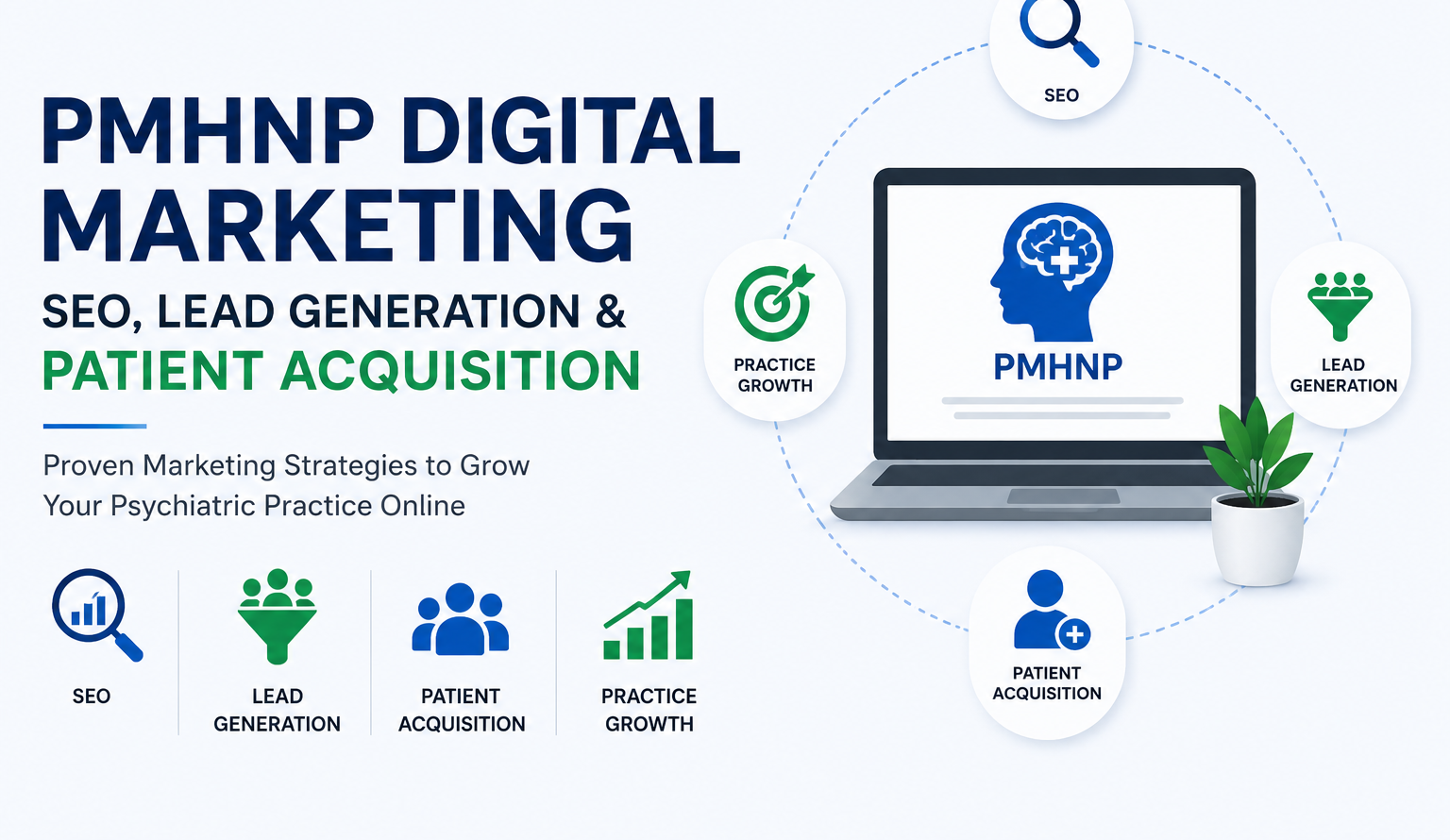
PMHNP Digital Marketing: How Psychiatric Practices Can Grow with SEO, Lead Generation, and Patient Acquisition
If your psychiatric practice is hard to find online, you are losing patients before the first conversation even happens. In today’s search-driven market, the practices that grow are the ones that show up clearly, build trust fast, and make the next step feel simple.

Why PMHNP marketing matters now
Patients do not choose providers the way they used to. They search Google, compare websites, scan reviews, check availability, and increasingly ask AI tools for recommendations before they ever submit a form. That shift has made psychiatric practice marketing far more competitive, but it has also made it more measurable. If your online presence answers the right questions and removes friction, you do not just get traffic. You get qualified inquiries.
97%
of consumers read reviews for local businesses, which means reputation is part of visibility, not just branding.
62%
would avoid a business if they found incorrect information online, a critical warning for practices with inconsistent listings.
45%
use generative AI tools for local business recommendations, showing how fast discovery behavior is evolving.
38.8%
of internet-using psychiatric patients in one study searched online for mental health services and professionals.
Those numbers matter because mental health decisions are trust-heavy. A patient looking for medication management, anxiety support, or telepsychiatry is often making a deeply personal decision under stress. BrightLocal reports that 97% of consumers read reviews for local businesses, 62% would avoid a business with inaccurate online information, and 45% already use generative AI tools for local business recommendations. That means discoverability, listing accuracy, and social proof all directly affect growth. [BrightLocal]
That online intent is especially strong in mental health. A PubMed Central study found that 57.8% of internet-using psychiatric patients searched online for information about mental disorders, while 38.8% searched specifically for mental health services and professionals. If your practice does not appear clearly in search, there is a real chance the patient will choose someone else who does. [PubMed Central]
In other words, PMHNP lead generation and PMHNP patient acquisition now begin long before the first intake call. They begin in search results, local listings, page structure, reviews, and the small trust signals that help people feel safe enough to act.
What United Web World provides
At United Web World, we provide PMHNP digital marketing, PMHNP internet marketing, PMHNP online marketing, PMHNP SEO, SEO for PMHNP, PMHNP SEO services, psychiatric practice marketing, PMHNP lead generation, and PMHNP patient acquisition services designed around how mental health patients actually search, compare, and book.
That means we do not treat psychiatric marketing like generic healthcare marketing. A PMHNP website must do more than rank. It has to communicate credibility, clarity, specialization, accessibility, and the right next step. Some practices need a better technical foundation. Others need location pages, medication management service pages, telehealth pages, or AI-ready informational content. Many need stronger conversion design so the traffic they already have turns into more consultations.
We also connect these services to the broader growth tools that support long-term search visibility, including a full SEO audit, advanced AI SEO, location-driven local SEO, strategy from an AI SEO agency, and scalable white label SEO services.
How modern PMHNP growth works
Search intent comes before traffic volume
A common mistake in online marketing is chasing broad traffic instead of qualified traffic. A PMHNP practice does not need random visitors. It needs people searching for relevant services such as psychiatric evaluations, medication management, telepsychiatry, anxiety support, depression treatment, ADHD care, or ongoing psychiatric follow-up. That is why effective SEO for PMHNP starts by matching specific intent to dedicated pages.
Your site must work for both humans and AI search
Google’s 2025 guidance for AI search experiences makes the direction clear: create unique, useful content for people, make sure pages are accessible and technically sound, and keep structured data aligned with visible content. That matters for PMHNP practices because shallow service pages and generic filler content are becoming easier for search systems to ignore. Specific answers, visible expertise, clean structure, and strong page experience are winning more attention. [Google Search Central]
Local trust still drives the click
Even the best content cannot help if your local presence looks incomplete. Patients notice missing hours, outdated phone numbers, thin reviews, or vague provider details. For PMHNP online marketing, local trust is not a side tactic. It is a direct ranking and conversion factor.

Conversion design is what turns visibility into growth
The real job of PMHNP digital marketing is not just to bring people in. It is to help them take action. The page has to answer, “Am I in the right place?” quickly. It has to reduce uncertainty with services, specialties, provider credibility, accepted patient types, and next-step guidance. When that does not happen, practices blame traffic when the real issue is page clarity.
What drives rankings and conversions
Below is a practical breakdown of the factors that usually move both visibility and booked inquiries for psychiatric practices.
| Factor | Why It Matters | What to Improve | KPI to Watch |
|---|---|---|---|
| Dedicated service pages | Improves topical relevance and helps match search intent | Create separate pages for core services, symptoms, and delivery types | Rankings + leads per page |
| Local optimization | Supports map visibility and city-based searches | Refine business profile, NAP consistency, reviews, and city content | Calls, map views, local rankings |
| Trust content | Mental health patients need confidence before contacting | Add provider credibility, treatment approach, FAQs, and expectations | Time on page + conversion rate |
| Technical SEO | Pages must be crawlable, fast, mobile-friendly, and indexable | Improve speed, structure, schema, and indexing quality | Core Web Vitals + indexed URLs |
| Booking experience | Friction hurts lead generation | Simplify contact forms, calls to action, and appointment steps | Form completion + booked consults |
Featured snippet takeaway: The fastest PMHNP growth usually comes from better intent matching, stronger local trust signals, and more conversion-focused service pages before publishing large volumes of content.
A step-by-step PMHNP marketing plan
-
Audit the website like a first-time patient.
Within five seconds, can someone tell who you help, what you treat, whether you offer medication management or telepsychiatry, and how to book? -
Build one page per major service or intent.
If everything is buried on one generic “services” page, the site will struggle to rank and convert. Clear separation strengthens both PMHNP SEO and patient understanding. -
Strengthen local trust signals.
Update business details, collect authentic reviews, refine your business profile, and make location cues visible across key pages. -
Create patient-first content.
Great PMHNP internet marketing content answers pre-booking questions such as what to expect, who the service is for, how medication management works, and whether telehealth is available. -
Optimize for AI-ready search visibility.
Use concise answers, clear headings, FAQ sections, structured content, internal linking, and original insights that support featured snippets and AI summaries. -
Reduce friction at the action step.
Use strong calls to action, short forms, clear contact pathways, and plain-language next steps that help turn attention into consultation requests. -
Track patient acquisition, not just rankings.
The real score is booked calls, qualified leads, attended consultations, and retained patients.
This is the point where strategy separates itself from random promotion. Real PMHNP patient acquisition is the result of connected systems, not isolated tactics.
Examples and mini case study
Three examples of content that works well
- Service page: “Medication Management for Anxiety and Depression in [City]”
- Trust page: “What to Expect at Your First PMHNP Appointment”
- Local page: “Telepsychiatry and Psychiatric Support for Patients in [State/Region]”
Mini case study: illustrative growth example
A psychiatric practice had a simple website with one generic homepage, weak service descriptions, and no clear local strategy. Traffic existed, but conversions were inconsistent. Instead of posting random blogs every week, the strategy shifted to focused service pages, better location relevance, stronger review prompts, FAQ-rich copy, and cleaner calls to action.
The result was not just better visibility. It was better-fit inquiries. Visitors landed on pages that matched what they were actually searching for, which improved both lead quality and conversion potential. That is the practical difference between broad promotion and structured psychiatric practice marketing.
Why online scheduling supports acquisition
Even operational details matter. One healthcare scheduling study found that online-booked appointments had a lower no-show rate than offline-booked ones, and online scheduling reduced unused and never-booked appointments. For practices focused on PMHNP lead generation, that means the booking system itself can affect growth efficiency. [PMC study summary referenced earlier]
Common mistakes to avoid
The first mistake is sounding vague. Patients do not search for “transformational holistic care ecosystems.” They search for help with symptoms, treatments, provider types, and availability.
The second mistake is relying on one page to rank for everything. If one page is trying to target medication management, telepsychiatry, depression care, anxiety support, and local intent all at once, it usually underperforms.
The third mistake is focusing only on traffic. More clicks without better page trust, booking clarity, or patient fit will not solve the underlying growth problem.
The fourth mistake is publishing AI-generated filler without real value. Unique, useful, structured content is far more aligned with current search systems than scaled generic text. That is why stronger PMHNP SEO services focus on quality, clarity, and search intent rather than word count alone.
FAQs
What is PMHNP digital marketing?
PMHNP digital marketing is the process of promoting a psychiatric mental health nurse practitioner practice through SEO, local search, website optimization, content, reviews, and online conversion strategy.
Why is SEO for PMHNP important?
SEO for PMHNP helps your practice appear when people search for psychiatric services, medication management, telepsychiatry, anxiety treatment, depression care, and local mental health support.
What do PMHNP SEO services usually include?
PMHNP SEO services typically include technical SEO, keyword mapping, service page optimization, local SEO, internal linking, content planning, on-page improvements, and lead tracking.
What is the difference between PMHNP lead generation and PMHNP patient acquisition?
Lead generation measures inquiries such as calls and form submissions. Patient acquisition measures how many of those leads become booked and attended appointments.
How long does PMHNP online marketing take to work?
Paid traffic can generate faster visibility, while SEO and organic growth usually build momentum over several months. The strongest results usually come when local SEO, content, and website conversion improvements are combined.
Ready to grow your PMHNP practice?
If you want a strategy built around real search behavior, stronger trust signals, and better patient conversion, United Web World can help you build a system that supports visibility and growth at the same time.
Author bio

United Web World Editorial Team
The United Web World Editorial Team specializes in search strategy, AI-ready content systems, local SEO, and conversion-focused marketing for service businesses. Our content is built with an E-E-A-T mindset, combining practical search knowledge, current visibility trends, and real-world growth strategy for brands that want more than just traffic.