


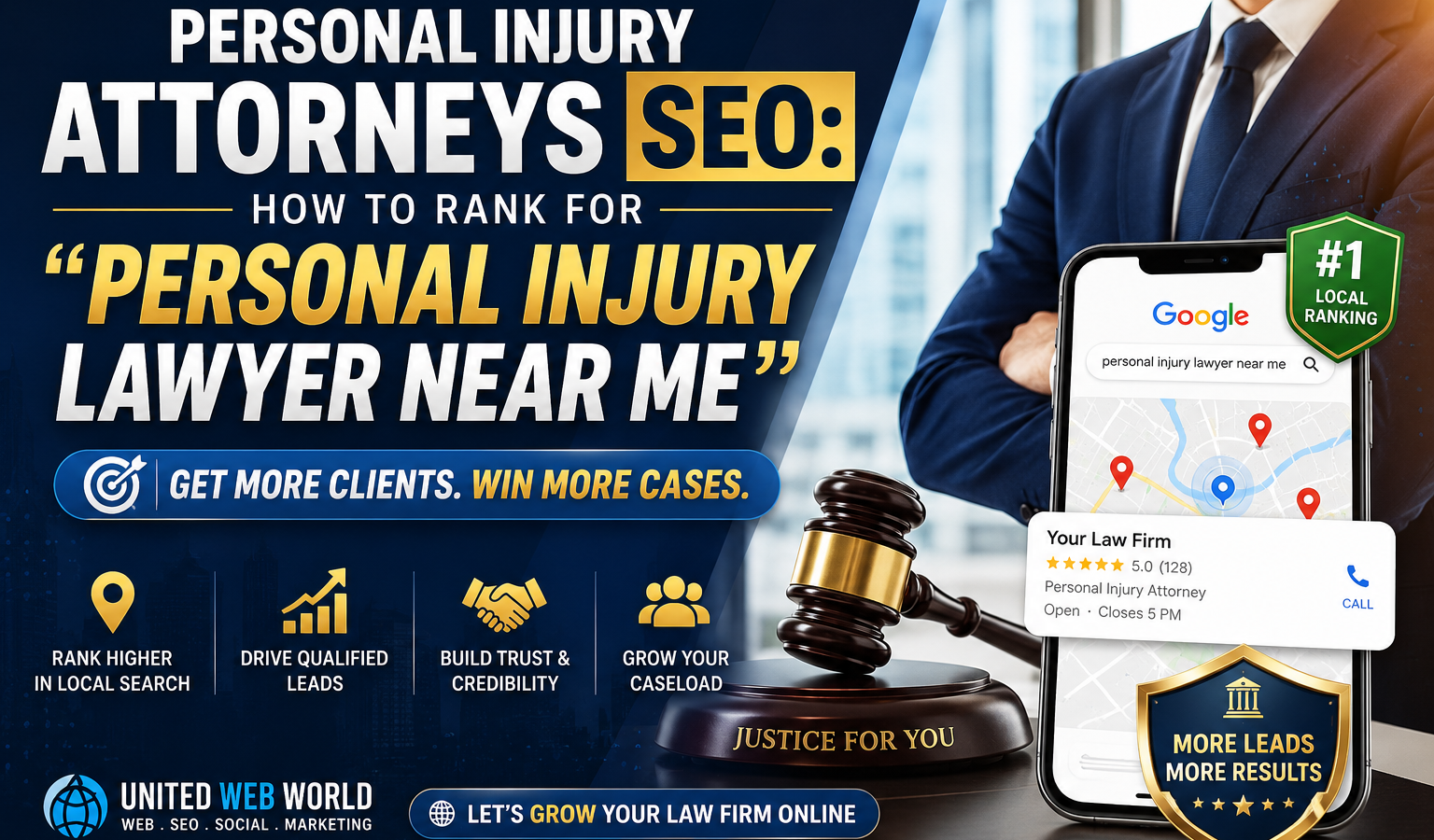
United Web World Guide to Personal Injury Attorneys SEO: Winning “Personal Injury Lawyer Near Me” Searches
If someone types “personal injury lawyer near me,” they usually are not researching casually. They are looking for help after a crash, fall, workplace injury, or insurance problem. The firms that win these searches are the ones that show trust, relevance, and urgency from the first click.

Why “personal injury lawyer near me” matters
The phrase personal injury lawyer near me may look simple, but it carries strong commercial intent. It usually means the person has moved beyond general research and is now trying to find a lawyer they can trust in a relevant area. In practice, that makes this one of the most valuable search behaviors for personal injury firms because the user is closer to contacting counsel than someone browsing broad legal definitions.
97%
of consumers read reviews for local businesses before making decisions, which makes reviews a major factor in legal trust. [BrightLocal](https://www.brightlocal.com/resources/local-seo-statistics/)
71%
of consumers use Google to read local business reviews, tying legal credibility directly to Google visibility. [BrightLocal](https://www.brightlocal.com/resources/local-seo-statistics/)
2.7x
more likely customers are to see a business as reputable when its Business Profile is complete. [BrightLocal](https://www.brightlocal.com/resources/local-seo-statistics/)
50%+
of consumers have used or would consider using AI to answer legal questions before contacting a lawyer. [Clio](https://www.clio.com/resources/legal-trends/read-online/)
That is why local legal visibility matters so much for personal injury attorneys. A complete business profile, accurate contact information, strong review quality, and a clearly structured website can influence whether an injured person feels comfortable enough to call. This is especially important because local trust and local search are now closely connected in Google’s ecosystem. [BrightLocal](https://www.brightlocal.com/resources/local-seo-statistics/)
Consumer behavior also shows that digital discovery is not an edge case anymore. More people say they would look online for their next lawyer, and firm websites and reviews play an important role in that process. At the same time, AI tools are influencing more early-stage legal research, which means the best personal injury content must be useful for both people and modern search systems. [Clio](https://www.clio.com/resources/legal-trends/read-online/)
What United Web World provides
At United Web World, we provide SEO and growth strategy for personal injury attorneys, including personal injury attorneys SEO campaigns built to improve local rankings, attract stronger leads, and support better case acquisition. We focus on the kinds of pages and signals that matter in high-intent legal search: case-type relevance, local trust, fast page performance, strong calls to action, and search-friendly site structure.
That work often includes technical cleanup, local optimization, internal linking, city and service pages, review support, FAQ development, and conversion improvements. We also connect these efforts to broader services such as a full SEO audit, advanced AI SEO, stronger geographic visibility through local SEO, support from an AI SEO agency, scalable white label SEO services, and dedicated legal strategy through our law firm SEO services page.
How injured clients actually search
They start with urgency, not legal terminology
Most injured prospects do not begin with perfect legal language. They search based on what happened, how they feel, and what they need right now. A person may search “car accident lawyer near me,” “slip and fall attorney,” “what to do after a truck accident,” or directly use a local intent term like “personal injury lawyer near me.” This means strong SEO should not only target formal case labels but also the real-world questions and worries surrounding them.
They compare quickly
In personal injury, prospects often evaluate several firms within minutes. They scan reviews, service pages, location cues, attorney credibility, and responsiveness. The winning site usually feels clear and confident, not cluttered or vague. That is why personal injury attorneys SEO is not only about ranking pages. It is about building pages that reassure someone in a stressful moment.
They want proof before they call
Even if someone is ready to speak with a lawyer, they want signals that they are choosing a capable firm. Practice focus, attorney bios, local presence, review quality, and case-type detail all influence that decision. Strong PI SEO supports that entire evaluation journey rather than treating ranking as the finish line.

They increasingly encounter AI-assisted legal discovery
Google’s 2025 guidance emphasizes useful, original content, strong page experience, crawlability, and clear structured content. For personal injury firms, that means shallow pages built from recycled legal text are less likely to stand out than pages that answer practical accident-related questions with specificity and clarity. [Google Search Central](https://developers.google.com/search/blog/2025/05/succeeding-in-ai-search)
What makes personal injury SEO different
Case urgency changes the buying journey
Someone searching for a personal injury lawyer may be dealing with pain, treatment, missed work, insurance pressure, vehicle damage, or uncertainty about who pays for what. That emotional and practical urgency changes how they read. They do not want vague brand slogans. They want answers that help them decide whether your firm can help right now.
Competition is higher and trust standards are stricter
Personal injury is one of the most competitive areas of legal search. That means generic city pages and weak attorney profiles usually struggle. A serious PI strategy needs stronger differentiation through case-type pages, local authority, structured trust signals, and pages that convert well on mobile devices.
Near-me intent favors firms with local depth
To rank better for personal injury lawyer near me, your site needs more than a location mention. It needs strong local cues, map relevance, profile completeness, accurate contact details, nearby authority signals, and service pages that clearly match what the searcher needs. This is one reason why personal injury firms that ignore local SEO often underperform even if they have decent content.
Ranking factors that drive real cases
Below is a practical breakdown of what typically matters most when personal injury attorneys want SEO that leads to consultations and signed cases.
| Factor | Why It Matters | What to Improve | KPI to Watch |
|---|---|---|---|
| Case-type pages | Better intent matching for accident-specific searches | Create pages for car accidents, truck accidents, slip-and-fall, wrongful death, workplace injury, and more | Rankings and leads per page |
| Local SEO signals | Essential for near-me and city searches | Refine Google Business Profile, location details, reviews, and local service pages | Map views, calls, local rankings |
| Review trust | Injured clients want reassurance before contact | Build consistent review growth and respond professionally | CTR and consultation rate |
| Technical SEO | Supports crawlability, speed, and mobile experience | Improve load speed, schema, page structure, and internal links | Indexed pages and Core Web Vitals |
| Conversion UX | Traffic has little value if users hesitate | Add visible calls to action, short forms, mobile click-to-call, and clear next steps | Calls, forms, booked consultations |
Key insight: Personal injury SEO is strongest when it combines accident-specific relevance, local trust, and an intake flow that feels fast and reassuring.
A practical growth plan for personal injury attorneys
-
Start with an intent audit.
Review whether your current pages actually match the searches you want to win. Many firms discover their homepage is trying to rank for everything while serving no one especially well. -
Build one focused page for each major injury type.
Car accidents, truck accidents, motorcycle crashes, pedestrian injuries, premises liability, and wrongful death deserve their own focused pages. -
Strengthen local signals.
Optimize your profile, contact details, office visibility, and city relevance so your firm is more competitive for “near me” and map-driven searches. -
Answer urgent client questions.
Publish useful pages like what to do after an accident, whether to talk to the insurer, how long a claim may take, and what evidence matters. These pages support both trust and search relevance. -
Improve conversion paths.
Personal injury prospects often search on mobile. Make calling easy, forms short, and next steps obvious. -
Optimize for AI-assisted search visibility.
Use concise answers, structured headings, strong FAQs, clear page purpose, and original explanations so your content is easier to surface and summarize. -
Measure signed-case performance, not traffic alone.
A smaller number of high-intent accident leads is often worth more than a larger volume of low-fit visitors.
This is where a ranking strategy becomes a revenue strategy. Personal injury firms grow faster when SEO is built around urgency, trust, and case-fit rather than traffic for its own sake.
Examples and mini case study
Three content examples that fit PI intent well
- High-intent page: “Car Accident Lawyer in [City]” with case types, common injuries, insurance issues, and CTA.
- Urgency page: “What to Do in the First 24 Hours After a Crash” with practical, local, action-oriented guidance.
- Decision-support page: “Do I Need a Personal Injury Lawyer for a Minor Crash?” for searchers who are unsure whether to contact counsel.
Mini case study: illustrative example
A personal injury firm had traffic coming to its homepage and a few blog posts, but non-branded accident searches were underperforming. The issue was not a lack of content. It was a lack of structure. Core injury pages were too broad, local signals were weak, and there was very little content helping users move from “I was hurt” to “I should contact this firm.”
Once the site was reorganized around case-type pages, stronger local relevance, clearer attorney trust signals, and faster mobile conversion paths, the traffic became more useful. That is the difference between having legal content and having SEO content built for the way injured people actually search.
Common mistakes to avoid
The first mistake is building one generic personal injury page and expecting it to rank for every accident type. It usually will not. The second mistake is focusing only on rankings and ignoring whether the page actually makes people feel ready to call. The third mistake is neglecting Google Business Profile and review growth even though local trust heavily affects near-me performance.
Another common issue is publishing content that sounds legally correct but emotionally disconnected. Personal injury prospects want confidence, clarity, and momentum. If the content feels vague, overstuffed, or obviously written just for search engines, it loses persuasive power. That is why the best personal injury attorneys SEO balances accuracy with human readability.
Finally, firms often underestimate how much mobile experience affects PI lead flow. Slow load speed, tiny buttons, long forms, and hidden phone numbers hurt the exact users who are most likely to search urgently from a phone.
FAQs
What is personal injury attorneys SEO?
Personal injury attorneys SEO is the process of improving a firm’s visibility for accident-related and injury-related searches so more qualified prospects can find the firm and request a consultation.
Why is “personal injury lawyer near me” such a valuable keyword?
Because it often signals strong local intent and urgency. The searcher is usually looking for a nearby lawyer they can contact soon, not just reading general legal information.
What pages should personal injury firms prioritize first?
Start with the homepage, car accident page, truck accident page, slip-and-fall page, wrongful death page, attorney bios, contact page, and local city or service-area pages.
How long does PI SEO take to produce results?
Early movement often appears in 3 to 4 months, while stronger gains in local rankings, call volume, and signed cases usually build over 6 to 9 months.
What makes personal injury SEO more competitive than other legal SEO?
Personal injury searches have high commercial value, strong local intent, and fierce competition. That means firms need better local trust, stronger case-type relevance, and clearer conversion design to stand out.
Want to win more high-intent personal injury searches?
If your firm wants stronger rankings, better visibility for “personal injury lawyer near me,” and more qualified consultations, United Web World can help you build an SEO system designed for local legal urgency and real case growth.
Author bio

United Web World Editorial Team
The United Web World Editorial Team specializes in SEO strategy, local search growth, AI-ready content systems, and conversion-focused website optimization. Our content approach combines practical ranking knowledge, local consumer behavior, and business-focused strategy for firms that need traffic to become inquiries, consultations, and clients.